
Viewing 25 - 30 out of 39
Patient Education

Retina and Vitreous
Macular Pucker
Macular PuckerMacular pucker happens when wrinkles or bulges form on your macula, affecting your central vision. In some cases, you won’t need treatment. Instead, your ophthalmologist may change your glasses or contact lens prescription to improve your vision. If your symptoms are more serious, you

Retina and Vitreous
Macular Telangiectasia
Macular telangiectasia (MacTel) is a disease affecting the macula, causing loss of central vision. In the early stages, people with MacTel will have no symptoms. As the disease progresses, you may have blurring, distorted vision, and loss of central vision. Because MacTel has no early symptoms, it is
Retina and Vitreous
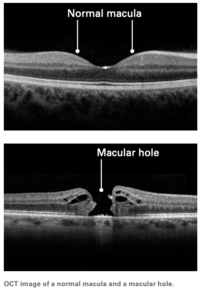
Optical Coherence Tomography
Optical coherence tomography (OCT) is a non- invasive imaging test. OCT uses light waves to take cross-section pictures of your retina. With OCT, your ophthalmologist can see each of the retina’s distinctive layers. This allows your ophthalmologist to map and measure their thickness. These measurements

Retina and Vitreous
Plaquenil
Plaquenil is a drug used to control symptoms from certain immune system diseases. If you take Plaquenil, it is important to see an ophthalmologist before and while you take this drug. This is because Plaquenil can cause damage to your eye’s retina. Your ophthalmologist will check the health of your

Retina and Vitreous
Posterior Vitreous Detachment
A posterior vitreous detachment is when the jelly-like vitreous in the middle of the eye separates from the back of the eye. A PVD is a normal process of aging. By age 70, most people will have one. Most people having a PVD don’t notice any symptoms. Other people will see floaters and flashes of light.

Retina and Vitreous
Retinal Angiography
Retinal angiography is when pictures are taken of the back of your eye. With these pictures, your ophthalmologist can closely see your retina and other parts of the eye. A colored dye is injected into your arm, where it travels to blood vessels in your retina. A special camera takes pictures of these

Contact Us Today
Please do not submit any Protected Health Information (PHI).
Monday
8:00 am am - 5:00 am pm
Tuesday
8:00 am am - 5:00 am pm
Wednesday
8:00 am am - 5:00 am pm
Thursday
8:00 am am - 5:00 am pm
Friday
8:00 am am - 5:00 am pm
Saturday
Closed
Sunday
Closed
Office Hours
Monday
8:00 am am - 5:00 am pm
Tuesday
8:00 am am - 5:00 am pm
8:00 am am - 5:00 am pm
Wednesday
Thuirsday
8:00 am am - 5:00 am pm
8:00 am am - 5:00 am pm
Friday
Closed
Saturday
Closed
Sunday
(954) 488-2020